

Performance Management Best Practices for 2026
PerformYard's 2026 study of 2,000+ companies shows how the tools HR teams choose shape feedback frequency, review completion, and goal outcomes. The findings point to three best practices every HR team should adopt.
2026 Report Overview
Key Findings
This report draws on anonymized PerformYard data from 2000+ organizations across every major industry. Three patterns separate the companies running effective performance management from those still stuck in annual-review cycles. You'll find the data behind each best practice in the sections that follow.
The clearest pattern in the data is that what separates effective performance management from broken processes is rarely budget or company size. It is the tooling underneath the process.

Tool Selection
Companies using dedicated software are 1.7x more likely to set strategic goals

Frequency
Only 27.8% of employees get feedback more than twice a year

Goal-Setting Methods
Collaborative goal-setting drives 74.9% review completion

Company Growth
PerformYard customers experience average headcount growth of 60% from Year 1 to Year 3,
Table of Contents
Key Findings
How Performance Management Tools Shape Outcomes
Cross-Sectional Data Shows Clear Winners:
The cross-sectional data shows that the type of tool used is the most significant determinant of the strengths of an organization's performance culture.
77% of Companies Use Manual Tools
Over 77% of companies use Google Sheets or their HRIS software for performance management processes.
Dedicated Software Drives Better Outcomes
Companies using dedicated performance management software achieve 1.7x more strategic goal-setting, cut review failure rates by 35%, and reduce HR admin time by over 60%.
Tool Choice Determines Feedback Frequency
Only 46% of spreadsheet users give feedback more than once a year, versus 69% of those using a dedicated performance management tool.
The admin drag of non-dedicated systems undermines strategic goal-setting and pulls HR away from coaching. Tool type predicted performance-culture strength more reliably than either company size or industry in our dataset.
The HR Toolbox
Most HR Teams Lack the Tools for Performance Management Best Practices
PerformYard's 2026 study found that 77.4% of organizations still run manual performance reviews on tools like spreadsheets and PDFs or a Payroll/HRIS system.
Only 22.6% use dedicated performance management software.
When performance management lives in a spreadsheet or a general HR module, it tends to function as an annual administrative task rather than a continuous, strategic process.
The reason is mechanical, not cultural. Manual tools have no reminder system, no audit trail, and no way to roll a cycle forward, so the path of least resistance is one large annual push.
That structural choice shapes every downstream outcome we measured.
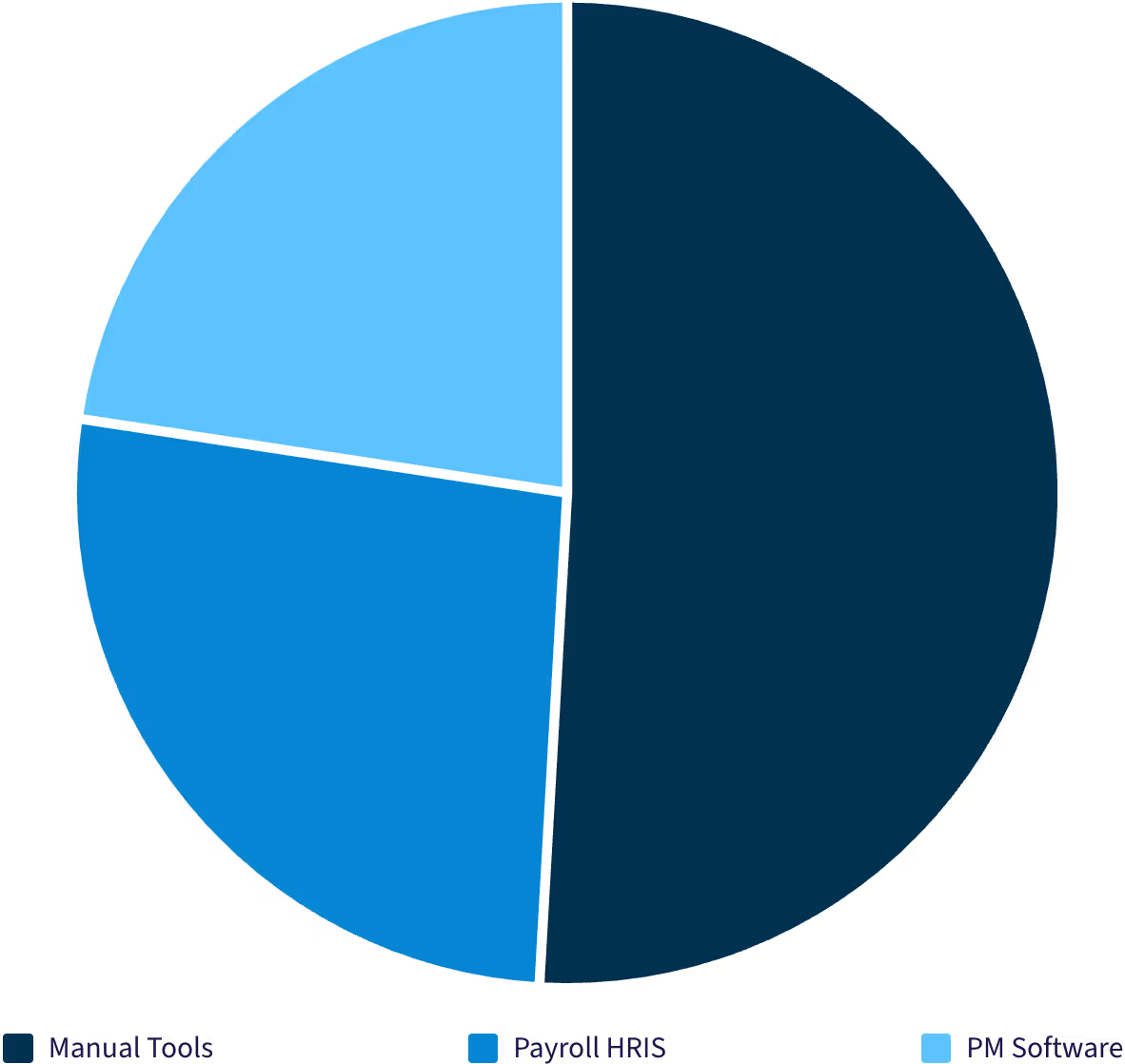
Breakdown of Tool Usage by Survey Respondents:
- Manual Tools: 50.9%
- Payroll HRIS: 26.5%
- PM Software: 22.6%
Best Practice #1
Use a Dedicated Performance Management Tool
PerformYard data shows that an organization’s choice of tool is the strongest factor shaping the quality of its performance management culture.
Across the dataset, companies using dedicated performance management software pulled ahead in three specific ways.
The Feedback Frequency Gap
Most Employees Get Formal Feedback Just Once a Year
Findings from PerformYard’s study show that an organization’s choice of performance management tool directly impacts how often employees receive feedback.
Non-dedicated software often forces HR teams to rely on annual or bi-annual cycles. For HR teams using manual tools and HRIS systems, more frequent review cycles are too complex or too much of an administrative burden.
The data confirms this trend, showing a significant bias toward infrequent feedback:
Only 27.8% of employees receive formal feedback more than twice a year. This gap between the business need for continuous feedback and the reality of infrequent cycles highlights a flaw in current HR performance management practices and tools.
The High-Frequency Leader
Organizations using Performance Management Software are the most effective at implementing frequent feedback, with 69% giving feedback more than once a year.
The Annual Trap
In contrast, most companies that use spreadsheets/PDFs run annual reviews. Manual tools are rigid and require work, preventing the shift to more agile feedback models.
Best Practice #2
Build Continuous, Multi-Method Feedback Systems
PerformYard data indicates that infrequent feedback is a major weakness in the overall performance landscape, with 72.2% of employees receiving feedback bi-annually or less often.
- The High-Frequency Leader: Organizations using performance management software are the most effective at implementing frequent feedback, with 69% giving feedback more than once a year.
- The Annual Trap: In contrast, most companies that use spreadsheets/PDFs run annual reviews. Manual tools are rigid and require work. As a result, they prevent the shift to more agile feedback models.
This suggests that the decision to give frequent feedback is less about company culture and more about the limitations of its HR tech stack.
Frequency is only half the problem. The PerformYard study also found that 68% of companies use annual reviews as their only formal method for assessing employee performance. No 360-degree feedback. No project-based reviews. No quarterly check-ins. Just one annual touchpoint.
/PDFs Tools)
Modern performance management requires more flexibility than one annual touchpoint provides. As reported by SHRM, employees actually benefit from ongoing dialogue through quarterly check-ins, 360-degree feedback, and/or project-based reviews.
Operational Efficiency
HR Loses Four or More Days to Every Review Cycle
Research from PerformYard shows that over 56% of organizations say HR spends four or more days managing reviews each cycle, and 34% report spending a full week or longer. This time sink reflects how manual workflows and scattered systems slow progress and add unnecessary administrative load.
The real cost is not the days themselves. It is the coaching and development conversations that never happen because HR is buried in admin work. That burden lands hardest in industries with heavy compliance documentation, such as healthcare and financial services.
Days HR Teams Spend Managing Reviews Each Cycle
- 7+ days: 34.6%
A plurality of organizations spend over a week per cycle - 4-7 days: 21.8%
Combined with 7+ days, 56.4% spend 4+ days on each cycle - 1-3 days: 28.6%
More efficient but still significant time investment - 1 day: 15.0%
The most efficient organizations
What’s the cause? PerformYard’s study finds that more often than not (63% of the time), performance reviews take so long to complete (or don’t get completed at all) because managers simply forget or deprioritize them.

Dedicated performance management software cuts down this time with automated workflows, Slack notifications, and centralized tracking. The result is days of admin work compressed into hours.
Review Completion Rates
Dedicated Software Cuts Review Failure Rates by 35%
Low review completion usually reflects a poor user experience, complicated processes, and missing reminders. These are common shortcomings of HRIS add-ons or manual tools that managers dread using. Dedicated performance management software addresses each one with automated workflows, Slack notifications, and centralized tracking.
HR's Three Biggest Barriers to Review Completion
Managers forget or deprioritize reviews
63.6% - Manager non-compliance is by far the biggest challenge, often reflecting poor user experience and lack of reminders.
Reviews are too much manual work for HR
19.1% - Administrative burden prevents efficient review cycles.
Employees don't see the value in reviews
17.3% - Lack of engagement stems from infrequent, poorly executed processes.
Best Practice #3
Set More Goals to Drive Higher Completion Rates
Data from PerformYard's 2026 State of Performance Management Report shows that employees who set 20–30 goals per year achieve 38% higher completion rates than those who set five or fewer. Yet most companies using manual tools for performance management fall into that lower range, limiting strategic alignment and impact.
Dedicated Software is the Catalyst: Companies using performance management software are 1.7x more likely to set 5+ goals compared to those relying on spreadsheets and PDFs. This gap highlights the software’s role in supporting complexity and tracking at scale.
The Plateau of Inefficiency: Nearly 80% of companies using HRIS or Spreadsheets for reviews stop at five or fewer goals per employee per year. These tools lack the necessary workflow to track numerous goals, forcing organizations to artificially limit their strategic focus.
Collaborative Goal-Setting Drives 74.9% Review Completion
Using performance management software is the first step to scaling and tracking goals, but PerformYard data shows true success comes when managers and employees set those goals together.
The method of goal-setting itself has a dramatic impact on whether a review is completed, suggesting that the goal's ownership creates accountability that transcends the tool used.
The swing is dramatic. Moving from no goals to collaboratively set goals lifts review completion from 57.5% to 74.9%, a 17-point gain driven entirely by who sets the goal, not which tool tracks it
Reviews linked to collaboratively set goals have the highest completion rate at 74.9%. Organizations with no goals at all see the lowest completion rate at 57.5%. Goal ownership is a powerful mechanism for driving review accountability.
What HR Teams Should Do Next
Manual Processes Prevent Effective Performance Management
Performance management in 2026 is still slowed by inefficiency and outdated tools.
Infrequent feedback, high HR admin costs, and inconsistent follow-through all stem from reliance on manual systems and general HRIS modules.
These tools treat performance management as an annual event, not a continuous process.HR professionals need a purpose-built solution.
How PerformYard Compares to Manual and HRIS Tools
Feedback Frequency
Current Reality: 72.2% of employees receive feedback bi-annually or less.
PerformYard Advantage: Enables continuous, quarterly, and monthly check-ins, aligning with business needs for agility.
HR Time Savings
Current Reality: 56.4% of HR spends 4+ days per cycle on administration.
PerformYard Advantage: Automates workflows, reminders, and data aggregation, reducing HR's time from days to hours.
Process Adoption
Current Reality: Manager friction is the top barrier (63.6%) to review completion.
PerformYard Advantage: Provides an intuitive, dedicated user experience for managers and employees, driving higher adoption and completion rates.
Data & Tracking
Current Reality: Data is siloed, hard to track, and often requires manual aggregation.
PerformYard Advantage: Offers centralized, real-time dashboards and reporting for immediate insight into process compliance and completion.
By choosing a dedicated platform like PerformYard, organizations can overcome the limitations and administrative inefficiencies of general tools and HRIS systems to implement a continuous feedback culture that drives employee development and business results.
Frequently Asked Questions
Get answers to common questions about PerformYard's 2026 Performance Management Best Practices study
How was the data for this performance management best practices study collected?
The data in this report comes from survey data from hundreds of anonymized organizations across every major industry and company size. It covers feedback frequency, review completion rates, goal-setting methods, and HR admin time, with patterns analyzed across tool type (dedicated software, HRIS, and manual tools).
How often is this report updated?
The Performance Management Best Practices study is updated every year with the latest trends, tools, and findings from PerformYard's customer base. Annual updates help HR teams benchmark their practices against current data rather than relying on industry trends from years ago.
Can I share this report with my team?
Yes! If you download the full report, share it with your HR team, your leadership, or anyone running review cycles. We hope you use the ideas in the report to help improve performance management at your company.
How can I implement these findings in my organization?
Start by reviewing the three best practices in the report against your current process. Pick one or two areas to test first, like increasing feedback frequency or shifting to collaborative goal-setting. Track the results over a quarter or two before expanding. Most HR teams see measurable improvements in completion rates within the first cycle of changes.
How do I get started with the PerformYard performance management platform?
PerformYard makes it easy to put these best practices into action. Sign up for a free demo to see how the platform handles reviews, goals, feedback, and reporting in one place. A dedicated customer success manager will walk through your specific process before you commit.
What are the top performance management best practices for 2026?
PerformYard's 2026 study found three best practices that separate effective performance management programs from struggling ones. First, use a dedicated performance management tool instead of spreadsheets or a general HRIS. Second, build continuous, multi-method feedback systems rather than relying on annual reviews. Third, set goals collaboratively between managers and employees. Companies that adopt all three see higher feedback frequency, higher review completion rates, and stronger goal outcomes.