

Performance Management Benchmarks for Construction (2026): PerformYard Data
TL;DR
We analyzed data from construction companies using PerformYard to find out how the industry is actually running performance management in H1 2026. The headline: annual reviews still dominate (49.9% of all cycles), but project-based reviews are the fastest-growing format at 15.2%. Goal-setting adoption hit 76%, AI usage inside performance management reached 85%, and the number-one initiative construction companies are pursuing this year is extending goal-setting from the office into the field.
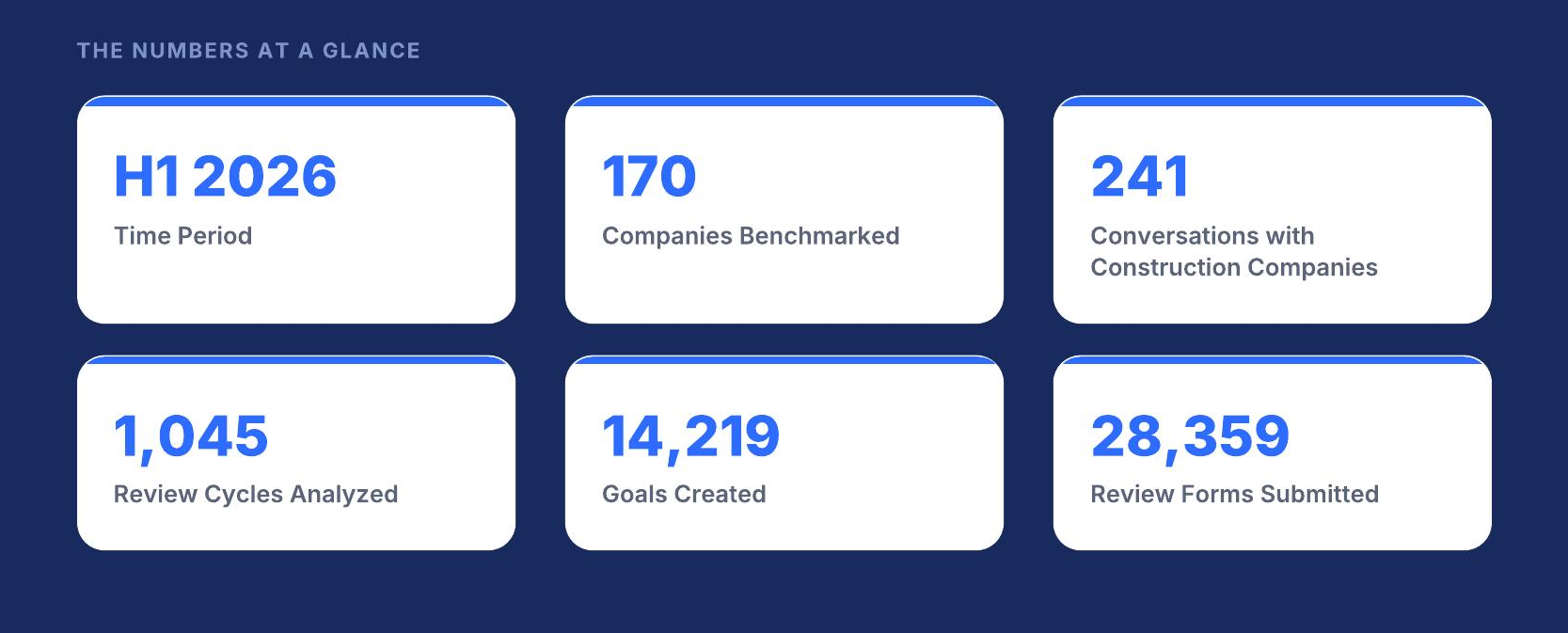
This post breaks down the full findings across reviews, goals, feedback, and AI adoption so you can benchmark your own program against the industry.
How Many Review Cycles Construction Companies Run
The median number of review cycles a construction company ran in H1 2026 depended heavily on company size. Mid-size companies (100 to 499 employees) led with a median of 3 cycles. Small companies (1 to 99 employees) ran a median of 2, and large companies (500+ employees) came in at 1.5.
That mid-size spike makes sense. Companies in the 100-to-499 range are typically large enough to need a formal process but still agile enough to run multiple cycle types, like combining an annual review with project-based check-ins.
Mid-size construction companies (100-499 employees) ran a median of 3 review cycles in H1 2026, the highest of any size bracket.
One important note: the average (mean) number of cycles per company was 7.9, far above every median. That gap is driven by a small group of companies running frequent monthly or project-based cycles, which pulls the average sharply upward. If you are benchmarking your own program, the median is the more representative comparison.
The Most Common Review Cycle Types
Annual reviews accounted for 49.9% of all review cycles started in H1 2026. Project-based reviews came in second at 15.2%, followed by quarterly (12.4%), onboarding (8.8%), monthly (7.4%), and mid-year (6.3%).
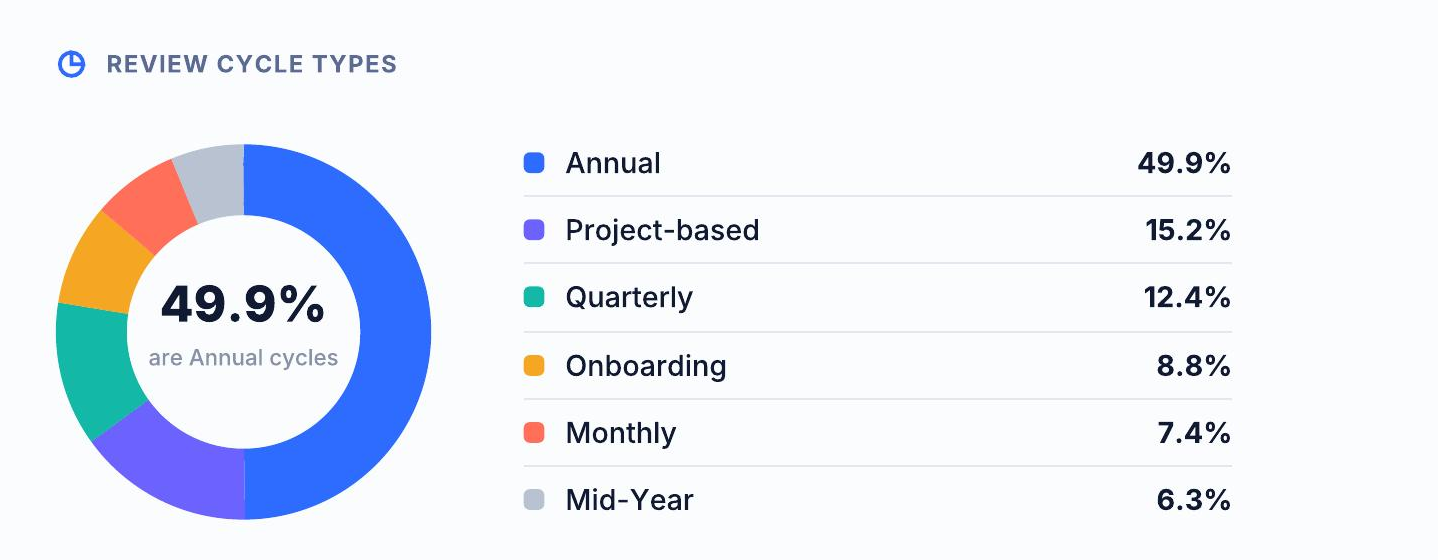
Share of review cycle types started, H1 2026. Source: PerformYard data.
Project-based reviews are worth calling out. Unlike annual or quarterly cycles that run on a fixed calendar date, project-based reviews wrap up when the project does. That makes them a natural fit for construction, where work is organized around jobs and phases rather than a standard review season.
When Construction Companies Launch Review Cycles
June is by far the busiest month for launching review cycles, accounting for 27.5% of all cycles started in H1 2026 (down slightly from 31.1% in H1 2025). This is consistent with mid-year check-ins timed to calendar-year fiscal cycles.
The rest of the months in 2026 show a slightly more even spread than 2025, which suggests more companies are staggering their cycles throughout the first half rather than clustering them at a single point.
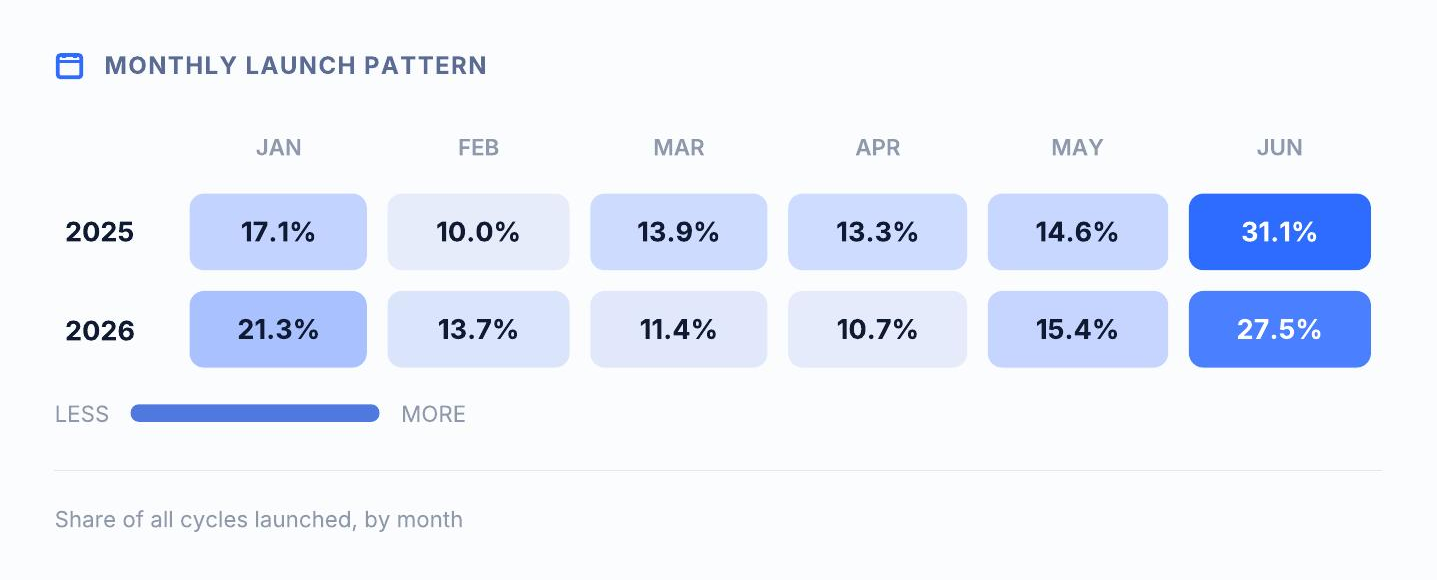
Share of all review cycles launched by month, H1 2025 vs. H1 2026. Source: PerformYard data.
How Construction Companies Set Goals
76% of construction companies in the dataset set goals in H1 2026. That is a strong majority, and it lines up with the top finding from our conversations: extending goal-setting into the field, for crews and site teams rather than just corporate staff, is the single biggest initiative construction companies are prioritizing this year.
76% of construction companies set formal goals in H1 2026, and extending goal-setting to field teams is the industry's top initiative.
When Goals Are Set
Goal-setting is heavily front-loaded. 38% of all goals set in H1 2026 were created in January alone, in line with calendar-year planning cycles. After that, February (15%), March (10%), and April (15%) show a more even distribution, with April's secondary peak likely reflecting Q2 kickoffs and project-based goals for teams that did not set annual goals in January. May and June each accounted for 11%.
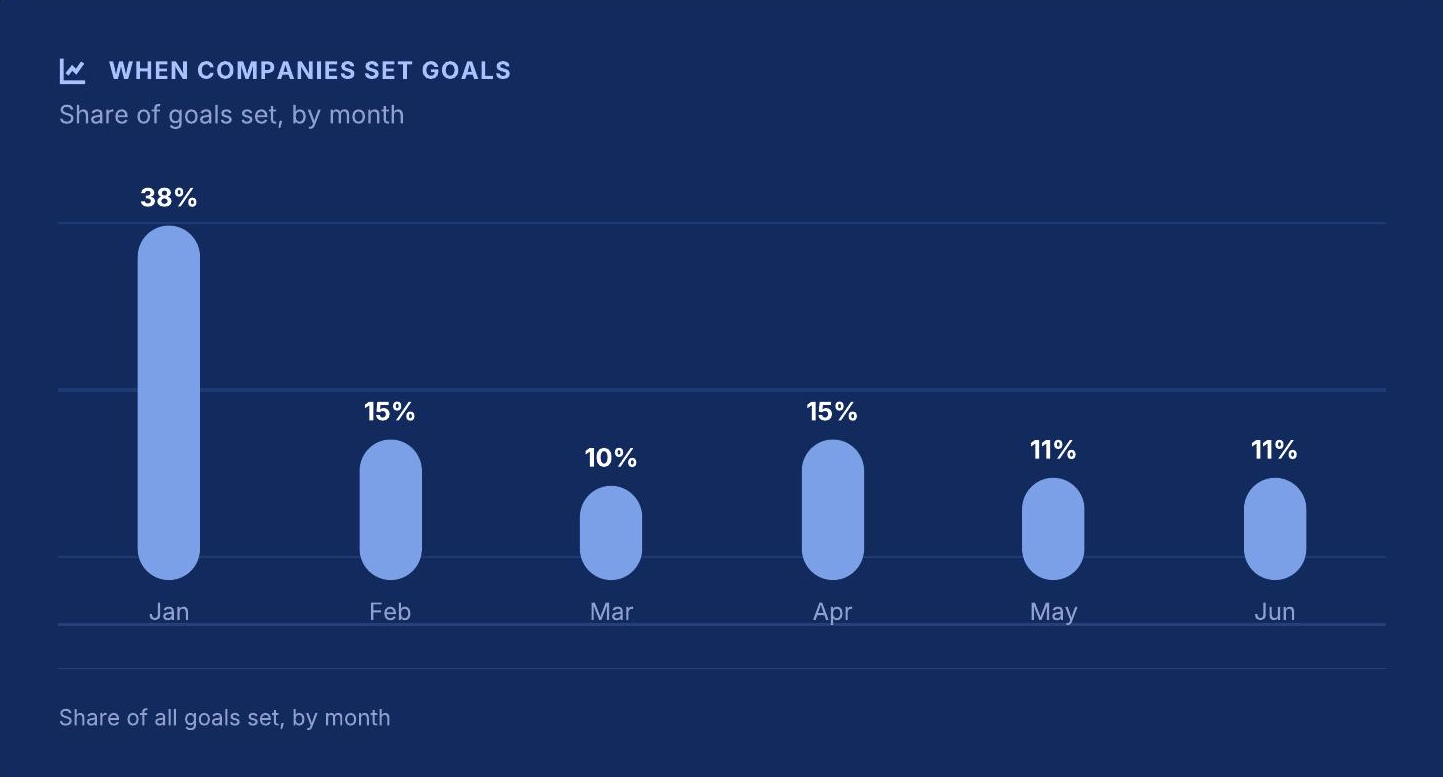
Share of all goals set by month, H1 2026. Source: PerformYard data.
Beyond Formal Reviews: 1:1 Meetings and Engagement Surveys
Two habits set apart construction companies with genuinely engaged teams: regular 1:1 meetings and a consistent cadence of engagement surveys.
1:1 Meetings
62.5% of construction companies ran 1:1 meetings in H1 2026. Research from SHRM and the O.C. Tanner Institute shows that teams running regular 1:1s are 3x more likely to be highly engaged and see a 27% drop in employee burnout. In an industry where turnover is a persistent challenge, that is a significant finding.
Construction teams that run regular 1:1 meetings are 3x more likely to be highly engaged and see a 27% reduction in burnout.
Engagement Survey Cadence
Among companies that run engagement surveys, the average interval between surveys was 91 days, essentially quarterly. Research from Gallup ties consistent engagement measurement to a 23% increase in profitability and an 18% decrease in employee turnover.
Pairing a quarterly survey cadence with regular 1:1s is what turns a survey score into an actual feedback loop rather than a once-a-year snapshot.
1:1 meeting adoption and engagement survey cadence, H1 2026. Source: PerformYard data.
How Construction Teams Are Using AI in Performance Management
85% of construction companies used AI in performance management during H1 2026. That number is high, but the breakdown of how they are using it is more telling.
What AI Is Being Used For
The overwhelming majority of AI usage is review writing assistance, which accounts for 73.2% of all AI requests. Review summarization is the clear second use case at 25.0%.
The takeaway here is that nearly three-quarters of AI usage inside performance management is people actively asking AI to help write reviews. It is hands-on, manager-initiated assistance rather than passive automation running in the background.
73.2% of AI usage in construction performance management is review writing assistance. Managers are actively using AI to write better reviews.
Top 5 Performance Initiatives Construction Companies Are Pursuing in 2026
Beyond the quantitative data, we spoke with construction companies to identify the top five initiatives on their minds this year:
1. Extending goal-setting into the field, not just the office
This was the single most common theme. Construction companies want field crews and site-level teams to have the same goal-setting structure as corporate staff, so performance expectations are clear regardless of where someone works.
2. Making leadership accountable through the same feedback loop as everyone else
Companies are pushing to include managers, directors, and executives in the same review and feedback processes as their direct reports rather than exempting leadership from the system.
3. Automating the administrative work behind performance management
This includes everything from automating review cycle launches and reminders to using AI to help write and summarize reviews. The goal is to reduce the time HR spends on logistics so they can focus on the conversations that matter.
4. Standardizing one performance framework across a growing or multi-entity business
As construction companies grow through acquisition or expansion, they are looking to unify disparate performance management processes into a single framework that works across all entities.
5. Consolidating performance, engagement, and 1:1s into a single platform
Rather than running separate tools for reviews, surveys, and meetings, companies want all of these in one place. Consolidation reduces complexity and makes it easier to see the full picture of an employee's performance.
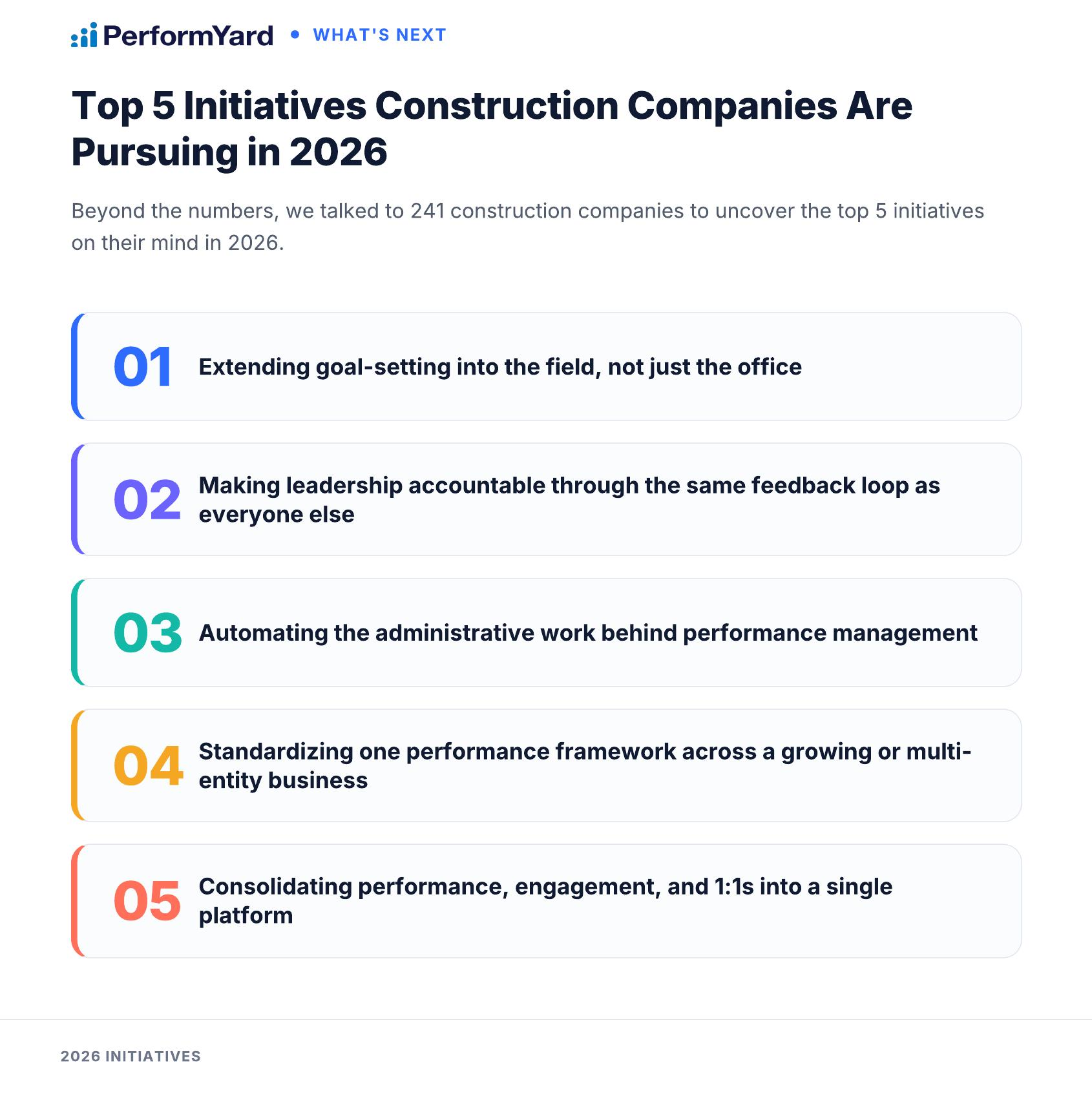
Top 5 initiatives from conversations with construction companies. Source: PerformYard.
Methodology
Findings in this report are based on data from construction companies using PerformYard, covering activity in H1 2026 (January through June). Median figures are used where noted specifically to reduce the influence of outliers; averages are called out explicitly where shown. Qualitative findings are drawn from conversations with construction companies during the same period.
FAQs
Q: How many review cycles do construction companies run per year?
A: Mid-size construction companies (100-499 employees) run a median of 3 review cycles per half-year. Small companies run 2 and large companies run 1.5.
Q: What percentage of construction companies use AI in performance management?
A: 85% of construction companies used AI in performance management during H1 2026, with 73.2% of AI requests being for review writing assistance.
Q: How often do construction companies run engagement surveys?
A: The average engagement survey interval among construction companies is 91 days, essentially a quarterly cadence.
Q: What is the most common type of performance review in construction?
A: Annual reviews account for 49.9% of all review cycles. Project-based reviews are the second most common at 15.2%, and are growing because they align with how construction work is organized around jobs and phases.

Performance Management Benchmarks for Healthcare: How Organizations Actually Ran Reviews in 1H 2026

Performance Management Benchmarks for Construction (2026): PerformYard Data

