

Performance Management Benchmarks for Healthcare: How Organizations Actually Ran Reviews in 1H 2026
TL;DR:
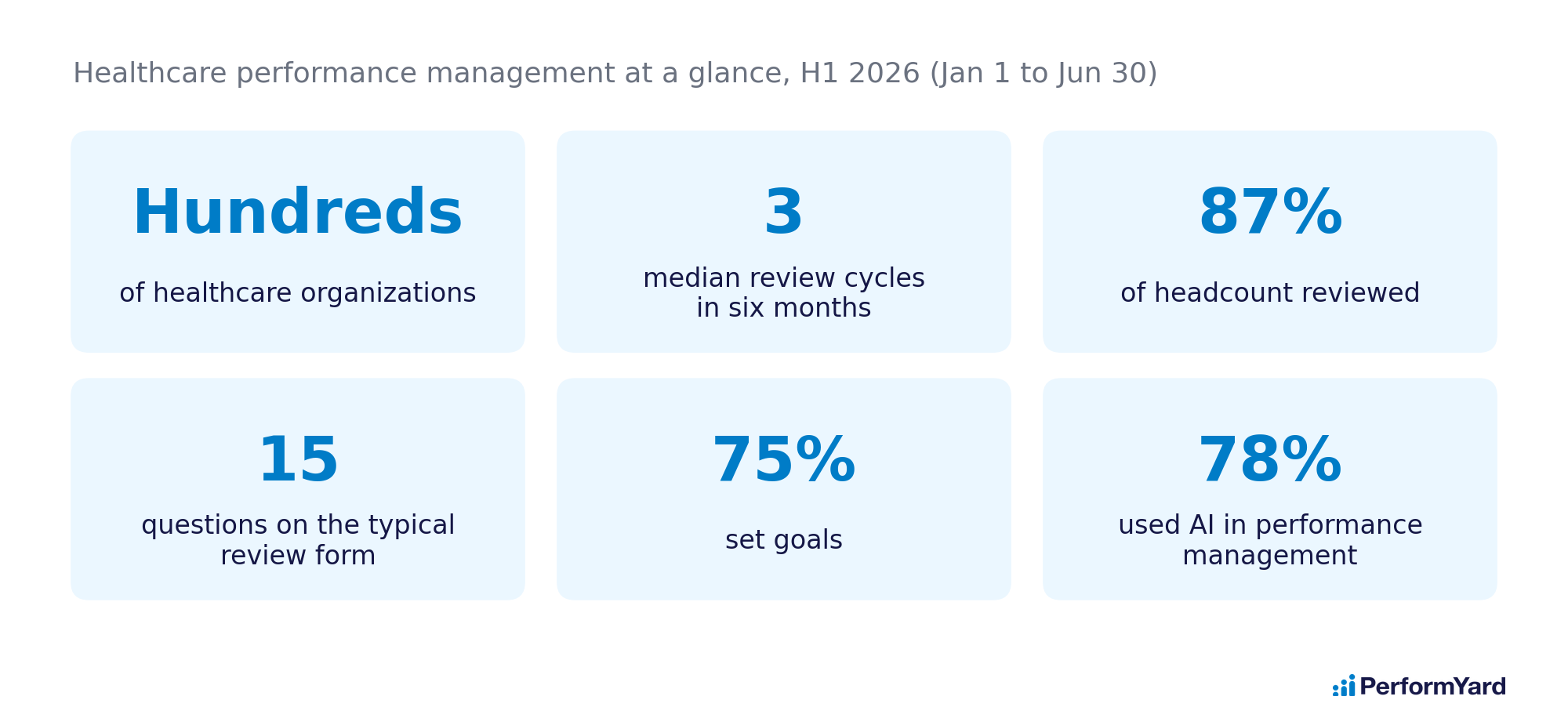
PerformYard measured how hundreds of healthcare organizations ran performance management from January through June 2026.
The typical organization ran three review cycles in the first half of 2026. On average, each review had 15-questions split evenly between rating scale and written questions.
75% of these healthcare organizations set goals in Q1 and Q2 of 2026, nearly all of them with a measurable numeric target. Lastly, a new trend this year: 78% of healthcare organizations used AI inside their performance management process.
Every figure below is measured from actual product usage rather than survey responses, so it reflects what healthcare organizations did, not what they said they do. Your healthcare organization can use this data to see how your performance management process compares to peers.
How Often Healthcare Organizations Run Reviews
Healthcare organizations that ran reviews in the first half of 2026 completed a median of 3 review cycles in six months, which puts the industry on a pace of roughly six cycles a year.
Although the annual review is still popular, a growing number of organizations run reviews more often than annually. 40% of healthcare organizations are running quarterly reviews, onboarding reviews, 30/60/90s, and PIPs.
That onboarding review is one of the more distinctive features of healthcare: 15% of all healthcare reviews are used to evaluate new hires, which reflects both the industry's hiring volume and its licensure and competency requirements for new clinical staff.
[IMAGE: 04_cycle_cadence.png]
Review cycle cadence, share of cycles with a stated cadence, H1 2026. Source: PerformYard platform data.
Healthcare organizations do a great job leveraging technology to run multiple review cycles. 37% of all cycles were automated, meaning they recur on a fixed schedule in PerformYard or trigger off each employee's hire-date anniversary.
Separately, 24% of healthcare companies set up different reviews for different departments rather than running company-wide reviews. That’s how these organizations ensure clinical, administrative, and support teams get custom-built forms and department-aligned timelines.
How Much of the Workforce Gets Reviewed
At the average healthcare organization, 87% of current headcount was the subject of at least one review during the first half of 2026. That is a high coverage figure for an industry with large shift-based and part-time workforces, and it held across size bands: 85% at organizations under 50 employees, 89% at 51 to 200, and 92% at organizations of 500 or more employees.
Not every review happened inside a scheduled cycle. 10% of the reviews in 1H 2026 were 360-degree or ad-hoc feedback requests initiated outside any cycle.
This is a sign that healthcare managers reach for the review process when they need it rather than only when the calendar says so.
The median healthcare organization reviewed 87% of its headcount in the first half of 2026, and 10% of all reviews were 360-degree or ad-hoc requests initiated outside a scheduled cycle.
What the Review Form Looks Like
The average healthcare review form asked 15 questions: 5 rating questions, 5 written questions, and the remainder a mix of goal-specific questions or multi-choice questions.
Healthcare reviews seem to be engaging, too. Only 9% of written questions were left blank, which suggests the forms are being filled out with care rather than clicked through.
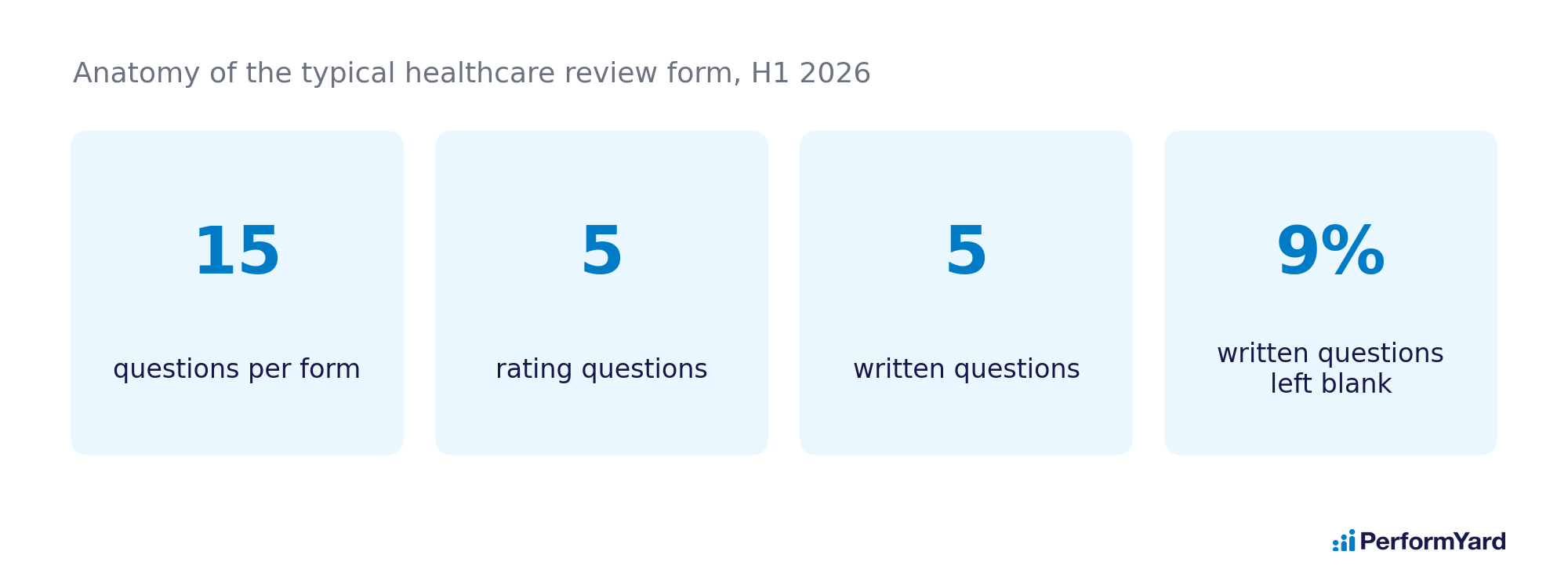
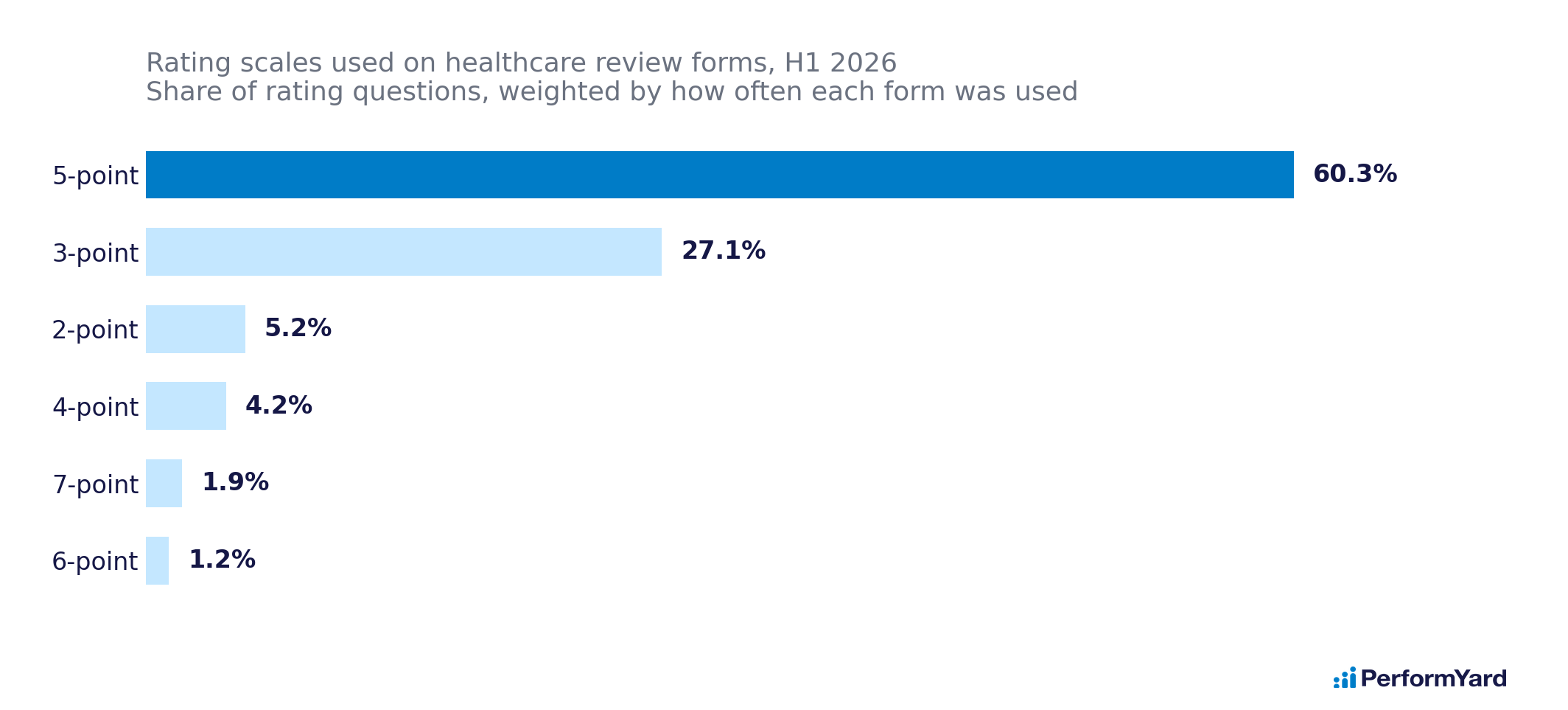
The median healthcare review form in H1 2026 had 15 questions, split evenly between 5 rating questions and 5 written questions, with employees leaving only 9% of written questions blank.
How Healthcare Organizations Set Goals
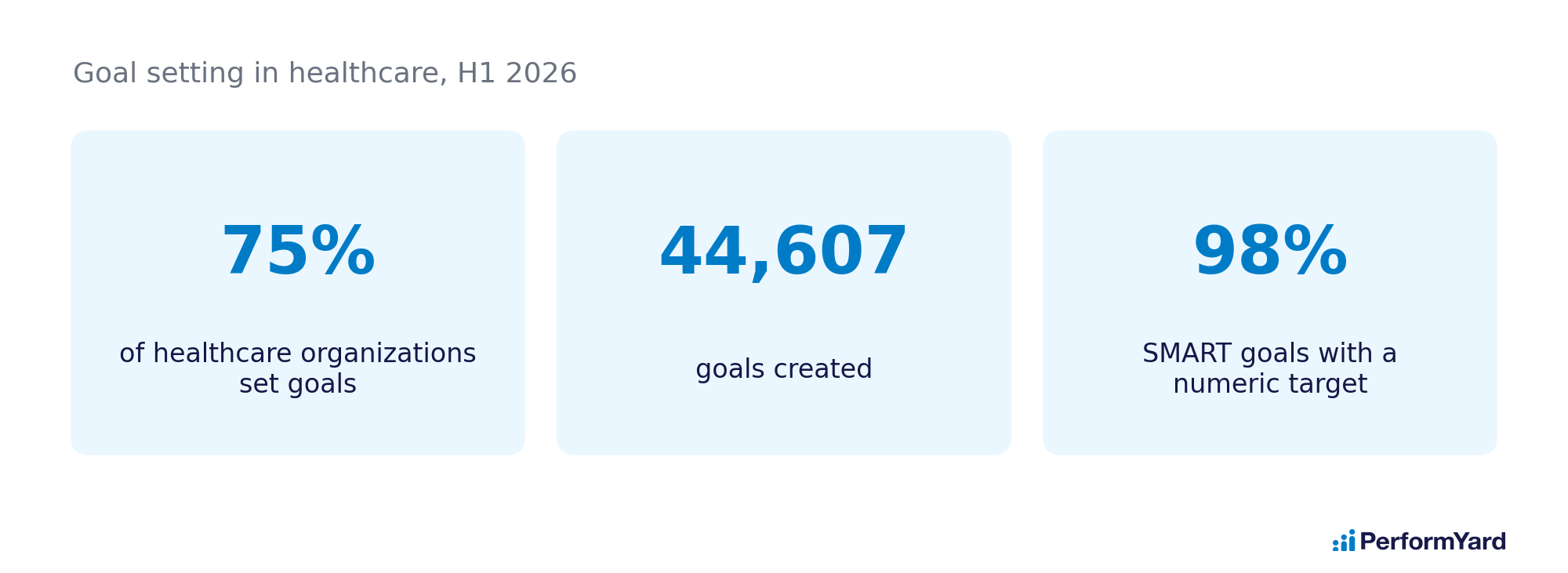
75% of healthcare organizations created goals in the first half of 2026, for a total of 44,607 goals in PerformYard. What stands out is how those goals are built.
Healthcare organizations tend to run on individual SMART-style goals tied to a person's role and review rather than on cascading company objectives aligned to overarching goals. That fits an industry where performance is defined by clinical standards, caseloads, and compliance milestones more than by top-down strategic targets.
When Goals Get Set
Goal-setting is front-loaded into the first quarter. January (9,465 goals) and March (11,268 goals) were the two peak months, and January through March together accounted for 64% of all goals set in 1H 2026.
March, rather than January, being the busiest single month is worth noting; it likely reflects goals being set during or immediately after Q1 review cycles rather than at the calendar turn, which is a healthy pattern because goals set in a review conversation tend to be more specific than goals set in a planning spreadsheet.
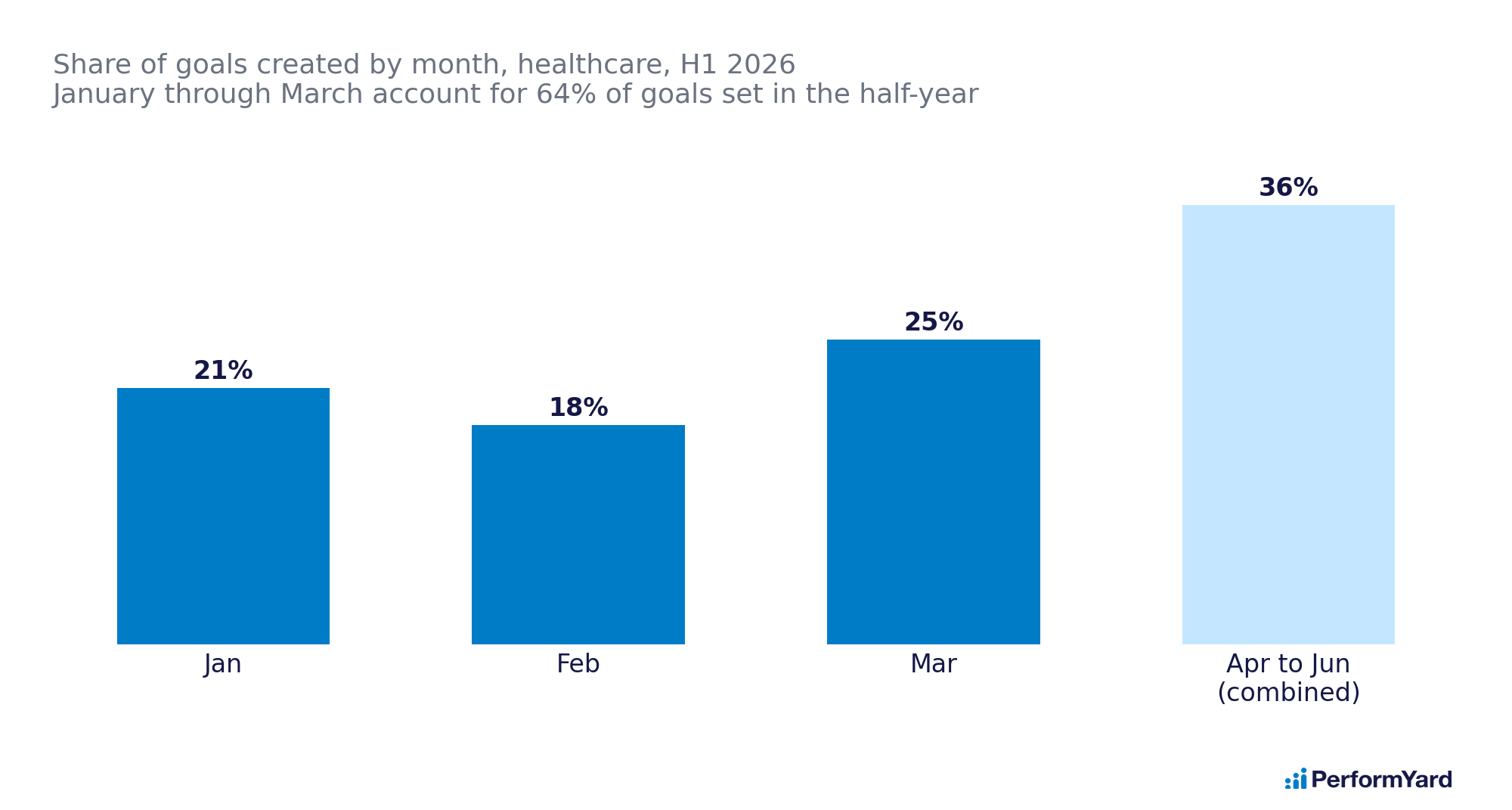
75% of healthcare organizations set goals in H1 2026. 98% of those goals were SMART goals that carried a numeric target.
How Healthcare Teams Are Using AI
78% of healthcare organizations with access to AI features used them in the first half of 2026.
These are people actively asking AI for assistance, most often with writing and summarizing reviews, inside their day-to-day performance management work.
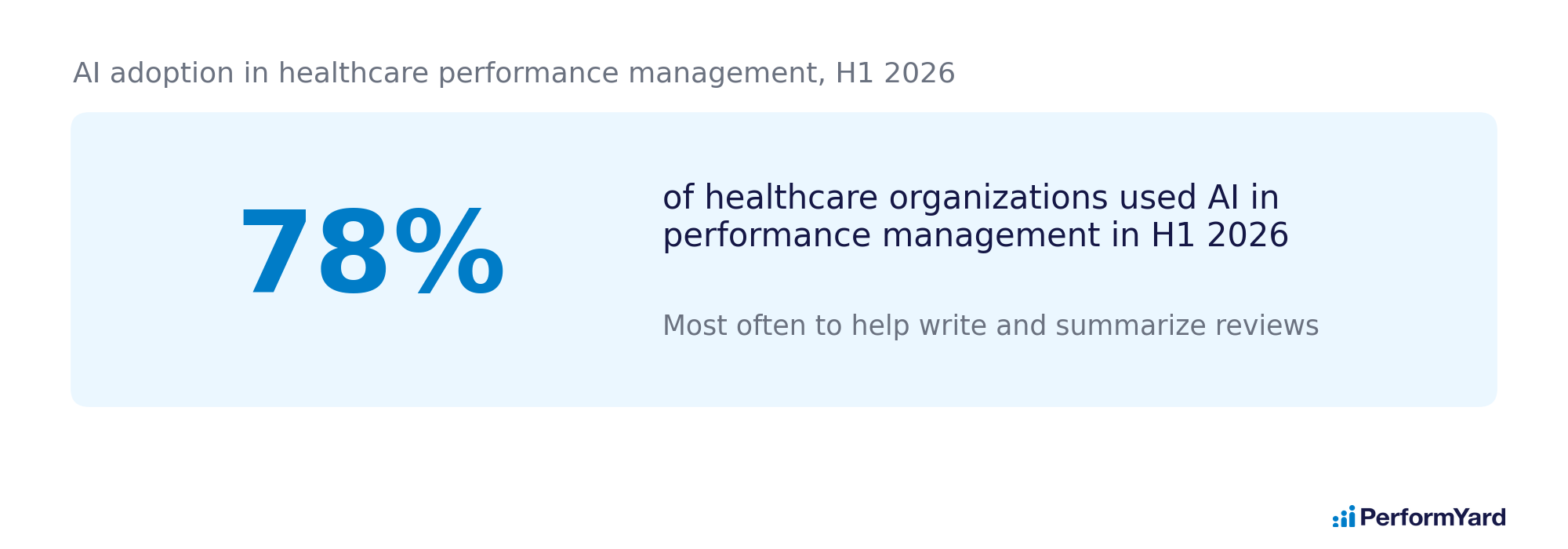
AI adoption in healthcare performance management, H1 2026. Source: PerformYard platform data.
AI Adoption Rises With Size
The clearest size effect in the dataset is AI adoption. 55% of organizations under 50 employees used AI in performance management, rising to 83% at 51 to 200 employees, 93% at 201 to 500, and 89% at 500 or more.
Larger organizations have more managers writing more reviews, and that is exactly the workload AI assistance was built to take on. For an industry often described as cautious about new technology, nine in ten mid-size and large healthcare organizations using AI in their review process is a notable number.
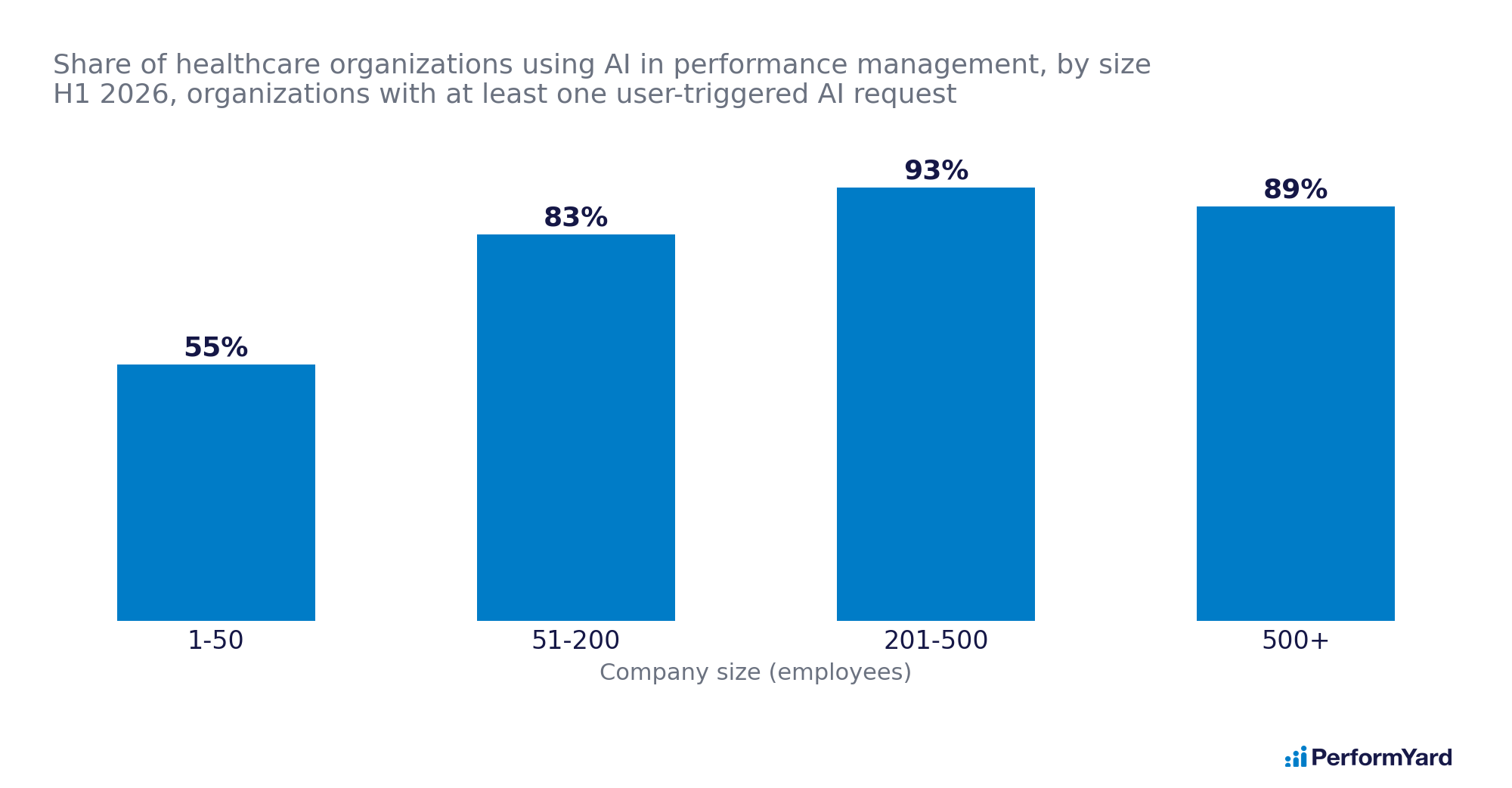
78% of healthcare organizations used AI in performance management in H1 2026, rising to 93% among organizations with 201 to 500 employees.
Engagement Surveys and eNPS
Healthcare organizations that run engagement surveys do so on a quarterly rhythm. Among the organizations with a configured survey cadence, the interval was 91 days, the same quarterly pattern we see in other industries and frequent enough to catch a problem before it shows up in turnover without creating survey fatigue.
Among the organizations that collected eNPS responses, the median score was 37. For context, an eNPS above 30 is generally considered strong, so the typical healthcare organization measuring it here is in good shape.
Healthcare organizations run engagement surveys every 91 days on average, and the median eNPS among those measuring it was 37.
Top 5 HR Initiatives Healthcare Organizations Are Pursuing in 2026
The usage data shows what organizations did. To understand what they are trying to change, we looked back at our conversations with healthcare organizations between January and early October 2026. Five themes came up most consistently.
1. Replacing paper and spreadsheet reviews with one system
2. Connecting performance data to the HRIS and payroll stack
3. Moving from a single annual review to more frequent check-ins
4. Tying evaluations to merit increases and bonus decisions
5. Making reviews satisfy accreditation and clinical competency requirements

Top 5 initiatives raised in conversations with healthcare organizations, January to October 2026. Source: PerformYard.
Methodology
Findings are based on product usage data from healthcare organizations using PerformYard, covering all employees and all activity between January 1 and June 30, 2026. Review cycle counts are reported for organizations that ran at least one cycle. Cycle cadence is inferred from cycle and template names and reported as a share of cycles whose name stated a cadence. Goal outcomes are reported for goals with progress recorded. AI adoption is measured from user-triggered requests. Any figure resting on fewer than five organizations is suppressed.
FAQs
Q: How many performance review cycles do healthcare organizations run per year?
A: Healthcare organizations completed a median of 3 review cycles in the first half of 2026, a pace of roughly six cycles a year, according to PerformYard platform data. Annual reviews remain the most common format, but 40% of healthcare organizations also run quarterly reviews, onboarding reviews, 30/60/90-day reviews, or performance improvement plans.
Q: What share of employees receive a performance review at healthcare organizations?
A: The typical healthcare organization reviewed 87% of its headcount in the first half of 2026, according to PerformYard platform data. Coverage held across company sizes, from 85% at organizations under 50 employees to 92% at organizations with 500 or more.
Q: How long is a typical healthcare performance review form?
A: The average healthcare performance review form in H1 2026 had 15 questions, including 5 rating-scale questions and 5 written-response questions, with the remainder goal-specific or multiple-choice. Only 9% of written questions were left blank.
Q: How do healthcare organizations use performance goals?
A: 75% of healthcare organizations set goals in the first half of 2026, and 98% of those were SMART goals with a numeric target. Healthcare organizations tend to use individual, role-based goals tied to reviews rather than cascading company-wide objectives.
Q: What percentage of healthcare organizations use AI in performance management?
A: 78% of healthcare organizations used AI in their performance management process in the first half of 2026, most often to help write and summarize reviews. Adoption rises with size, reaching 93% among organizations with 201 to 500 employees.
Q: How often do healthcare organizations run employee engagement surveys?
A: Healthcare organizations that run engagement surveys do so every 91 days on average, a quarterly cadence. Among those measuring eNPS, the median score was 37.
Q: What are healthcare organizations prioritizing in performance management in 2026?
A: The five most common initiatives are replacing paper and spreadsheet reviews with one system, connecting performance data to the HRIS and payroll stack, moving from a single annual review to more frequent check-ins, tying evaluations to merit increases and bonus decisions, and making reviews satisfy accreditation and clinical competency requirements.

Performance Management Benchmarks for Healthcare: How Organizations Actually Ran Reviews in 1H 2026
.jpg)
Performance Management Benchmarks for Construction (2026): PerformYard Data
.jpg)
